
Are You Mistaking Qualification for Selection?

If you’ve ever sat in a pre-bid meeting, poured your soul into a proposal, or waited anxiously for a selection committee’s call, you’ve felt the pressure. You know your firm is qualified, your team is experienced, and your safety record is solid.
But so are your competitors’.
In today's market, technical competence is the price of admission. It gets you a seat at the table, but it doesn't get you the job.
So, what wins the job?
It’s a fundamental shift in the question being asked. When a committee stares at a shortlist of nearly identical firms, they aren’t asking, “Who can build this?” They’re asking the billion-dollar question: “Who will screw this up the least?”
Owners aren’t just evaluating your capabilities—they’re assessing their risk—and the single most powerful way to mitigate that risk is by building unshakable trust.
The New Currency of Trust: It’s Not Your Brochure
Forget the glossy brochures for a moment. Your most valuable business development assets aren’t things you create; they’re things you earn.
They are the echoes of your success, and they speak louder than any slogan. This is called social proof—the psychological principle that people look to the actions of others to guide their own decisions, especially under pressure.
Imagine two scenarios:
Scenario A: A selection committee reviews your proposal, a tome of promises. They’re anxious, guarded, and see right through hollow sales pitches.
Scenario B: The same committee reviews your proposal. But this time, they see a testimonial from a Fortune 500 CFO explaining how you delivered their complex project under budget. They flip through a case study detailing how you navigated a supply chain disaster. They see your president quoted as an expert in an industry journal.
The mood shifts. The question changes from “Who will screw this up?” to “Why would we risk working with anyone else?”
That is the power of social proof. It’s the silent salesperson in the room, the one with the most credible voice of all—your satisfied clients.
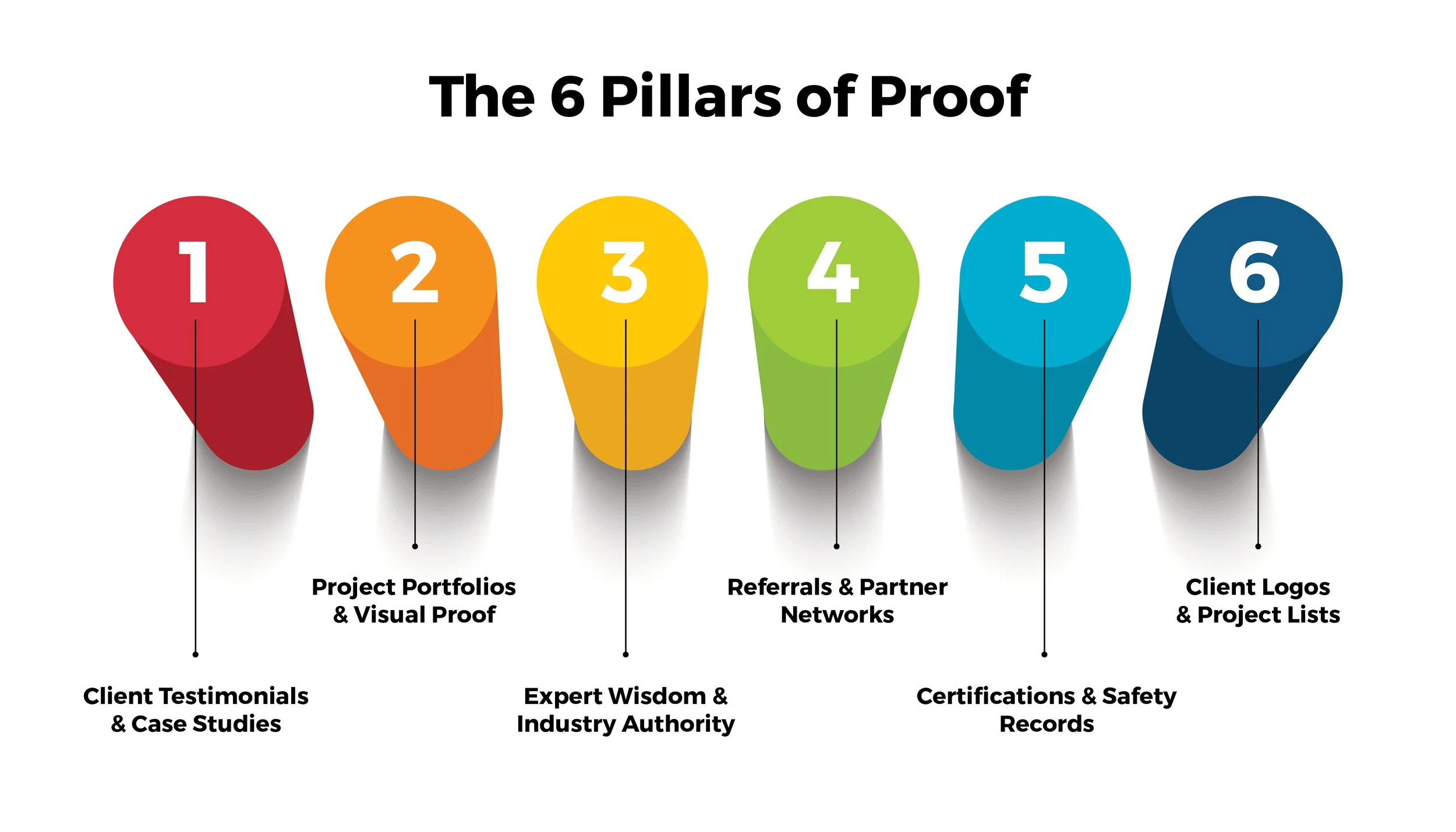
The Six Pillars of Proof: Your Arsenal of Influence
Building this trust isn't a mystery. It's a strategic process of collecting and showcasing proof. Think of these as the six foundational pillars of your firm's reputation:
Client Testimonials & Case Studies: This is your proof of concept. A case study isn't a story; it's an evidence file that demonstrates, with data, that you do what you say you will do.
Project Portfolios & Visual Proof: A single, high-resolution photo of a flawless installation says more than a thousand words about your quality. Drone footage and virtual tours make your capabilities tangible.
Expert Wisdom & Industry Authority: Awards, speaking engagements, and media features are deposits of credibility into your brand’s bank account, signaling that experts recognize your excellence.
Referrals & Partner Networks: A warm introduction from a trusted architect or past client is the closest thing to a guaranteed win—a direct transfer of trust.
Certifications & Safety Records: Your ISNetworld status, safety record (EMR and LTAs), and safety awards are public declarations that you operate at the highest level of professionalism and you care about your employees' well-being.
Client Logos & Project Lists: Displaying high-profile client logos triggers a powerful psychological response: “You are in good company.”