

Construction Marketer’s Guide to Gated Content

What is Gated Content?
Gated Content is any valuable digital resource—like a guide, checklist, or tool—that a website visitor can access only after providing their contact information, typically via a form.
The "Gate": A form field requesting details like name, company, email address, and sometimes project type or timeline. Sometimes it's as simple as an email address.
The "Content": The high-value resource placed behind that form.
The Simple Analogy for Construction: Think of it like a secured job site. You wouldn't let just anyone walk onto a active construction site—it's a security and liability risk. Instead, you have a gate where approved personnel must sign in to gain access. Similarly, you don't give your most valuable strategic insights to every casual visitor. You place it behind a "gate" where serious prospects "sign in" (provide their info) to get the keys.
Ungated Content (like blog posts or project galleries) is designed to attract a wide audience and improve search engine optimization (SEO), while gated content is designed to convert that audience into known leads for your sales team.
The Value of Gated Content for Construction Marketers
In an industry with long sales cycles and high-stakes decisions, gated content is not a minor tactic; it's a fundamental strategy for business development.
Generate Qualified Leads: This moves beyond collecting business cards at events. A download of a "Pre-Construction Checklist" signals a prospect who is actively planning, making them a self-qualified lead for your business development team.
Build Trust & Demonstrate Expertise: No one awards a multi-million dollar contract based on a sales pitch alone. By giving away valuable knowledge first, you position your firm as a consultative expert, not just a vendor. This builds the "know, like, and trust" factor essential for winning work.
Quantify Marketing ROI: It transforms marketing from a cost center to a measurable pipeline engine. You can track which content topics generate the most leads, which convert to meetings, and ultimately, which contribute to closed deals, justifying your marketing budget.
Nurture Leads Through Long Sales Cycles: A construction sale can take 6-18 months. Gated content provides the fuel for email nurture campaigns, keeping your company top-of-mind with relevant, helpful information until the prospect is ready to issue an RFP or request a consultation.
Segment Your Audience: The topic a lead downloads tells you who they are. A "Technical Guide on Building Envelopes" suggests a facilities manager, while a "Guide to Construction Financing" suggests a developer. This allows for hyper-targeted follow-up.

Mapping Gated Content to the Construction Buyer's Journey
This framework ensures you provide the right information at the right time, strategically guiding prospects through the buyer's journey. What is the buyer's journey?
In commercial construction, the buyer's journey is the meticulous, often lengthy, process that property owners, developers, and facility managers undertake to solve a capital need—from a vague idea to a completed building. This journey is defined by four critical stages:
1. The Awareness Stage
The Awareness Stage is where the construction buyer identifies a core business problem or opportunity, such as operational inefficiency, market expansion, or a failing facility system.
2. The Consideration Stage
The Awareness Stage evolves into the Consideration Stage, where the buyer has fully acknowledged the problem or opportunity and is now rigorously evaluating all potential solutions—whether to renovate, build new, or expand—and forming a longlist of potential construction partners and project delivery methods.
3. The Decision Stage
The journey narrows into the Decision Stage, where the buyer, now with a defined project scope, is shortlisting contractors, scrutinizing proposals, and ultimately selecting the firm they trust to mitigate risk and deliver on time and budget.
4. The Loyalty Stage
Crucially, the journey extends beyond the award of the contract into the Loyalty Stage, where the quality of the construction experience, communication, and final result determines whether the client becomes a source of repeat business and powerful referrals, solidifying a contractor's reputation in a relationship-driven industry. This stage is often overlooked by contractors.
Aligning the Buyer's Journey and the Sales Funnel
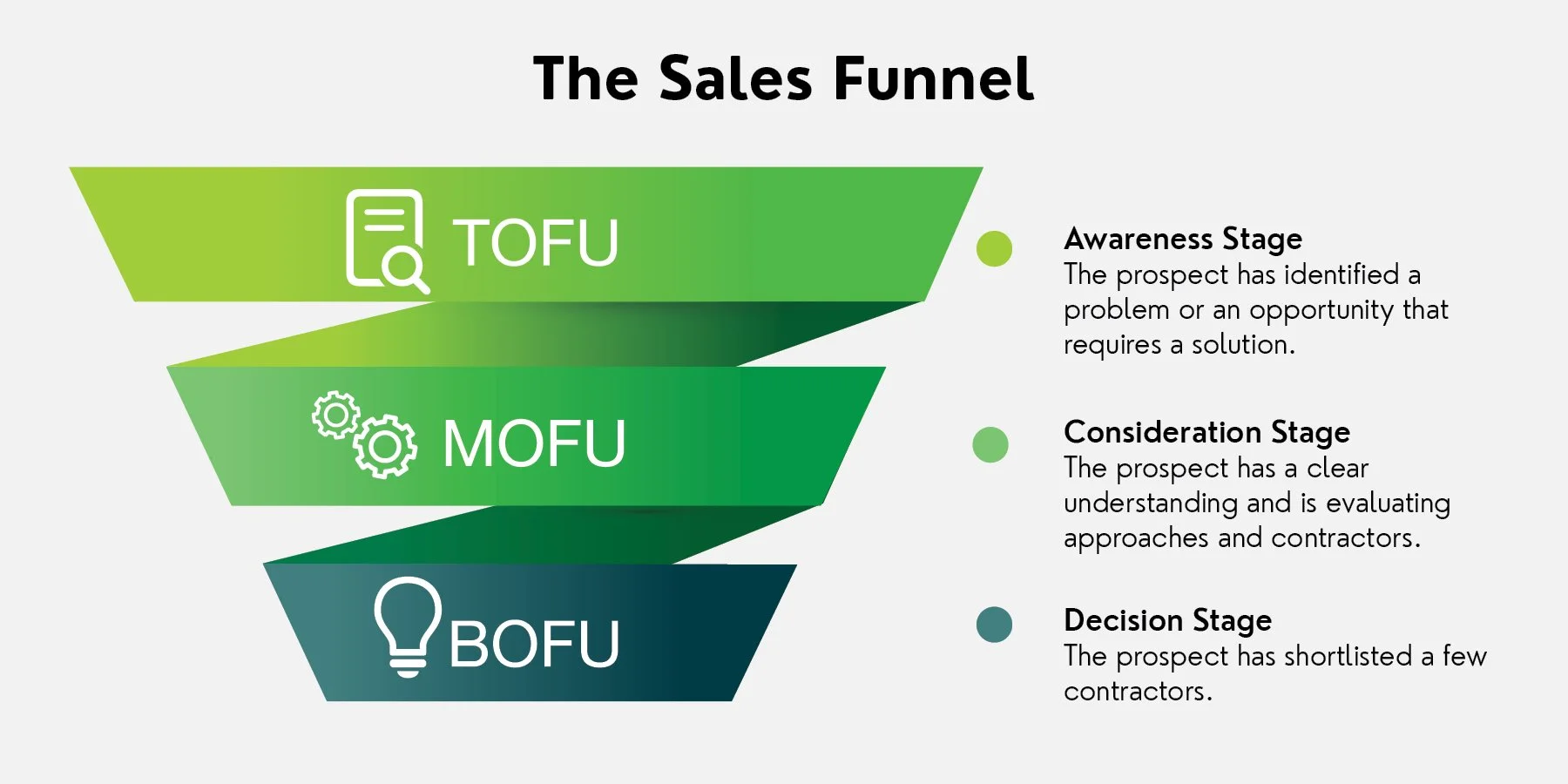
Now that you understand the buyer's journey, you can develop content to align with the various stages. This is what we like to call the sales funnel. It's wider at the top and narrower at the bottom. The Top of the Funnel (TOFU) correlates with The Awareness Stage, the Middle of the Funnel (MOFU) aligns with The Consideration Stage, and the Bottom of the Funnel (BOFU) represents those construction buyers in The Decision Stage. Here's how it works:
Tier 1: Top of Funnel (TOFU) - The “Awareness” Stage
Buyer's Mindset: "I have a problem or opportunity (e.g., our facility is outdated, we need to expand)."
Your Goal: Educate, attract, and capture lead information by offering foundational guidance. Here are some examples:
eBook: "The Owner's Guide to Commercial Project Delivery Methods." This positions your firm as a strategic educator on a critical, foundational topic.
"Pre-Construction Planning Checklist." This provides immediate, practical utility and attracts serious, organized owners.
PRO TIP: At this stage, do not ask for anything other than the prospect’s name and email address. Asking for more personal information at this stage is usually a deterrent. It’s more about getting the asset into the hands of the prospect than it is about gathering information about them. You can gather additional information about the prospect when they make future downloads.
Tier 2: Middle of Funnel (MOFU) - The “Consideration” Stage
Buyer's Mindset: "I understand my problem and am now evaluating different approaches and contractors."
Your Goal: Demonstrate capability and build trust to get on the shortlist. Here are some examples:
Case Study: "How We Delivered the XYZ Hospital Wing On-Time Amidst Supply Chain Disruption." This provides social proof and tangible evidence you can solve complex, real-world problems.
Webinar: "A Deep Dive into Value Engineering Strategies." This showcases your experts in real-time and generates a list of highly engaged, hot leads.
Tier 3: Bottom of Funnel (BOFU) - The “Decision” Stage
Buyer's Mindset: "I've shortlisted a few companies. I need to justify my final decision to my board/partners."
Your Goal: Overcome final objections and provide the justification to select your firm. Here are some examples:
Safety & Compliance Portfolio: This directly addresses the top concern for corporate clients: risk mitigation. This can be the deciding factor.
Value Engineering Playbook: This content offers a concrete, financial justification for your selection, speaking the language of ROI to financial decision-makers.
The Strategic Shift
Offering gated content to your prospects represents a shift from promoting your company to empowering your clients. It’s a long-term investment in building a pipeline of educated, trusting, and qualified leads. By providing value first, you don't just win projects; you build the lasting partnerships that are the foundation of a successful construction business.
Want some tried-and-tested tactics to generate qualified leads? Download The 5 Content Types That Fill Your Pipeline guide below. [This is TOFU gated content!]