Why Quality and Safety Aren’t Differentiators

You’ve sat through the pitch. You’ve listened to competitors—and perhaps your own team—rely on the same tired trifecta: “We deliver quality, safely, on time.”
In a market saturated with near-identical messaging, these words have become meaningless white noise. They are the price of entry—the absolute minimum requirements—not a compelling reason for a high-stakes client to choose you over the rest of the field. When your value proposition is indistinguishable, you are forced to compete on one thing, and one thing only: price. This race to the bottom erodes your margins, stresses your team, and attracts the wrong kind of clients.
The core challenge for today’s construction professionals isn’t just building great projects; it’s building a great company that stands apart. It’s about articulating a Unique Value Proposition (UVP) so clear and compelling that it justifies a premium, attracts your ideal projects, and allows you to move away from reactive bidding toward proactive client selection.
Why Your "Differentiators" Are Actually Minimum Requirements
No owner or developer actively seeks out a contractor who is not quality-focused, not safe, not able to complete a project within budget, or known for being late. These are non-negotiable, baseline expectations. Claiming them as differentiators is like a restaurant advertising "edible food." Would you eat there?
The real question you must answer is: “How do we deliver on these promises in a way that is uniquely valuable and fundamentally different from our competitors?”
This is where most construction marketing stalls. Brochures and websites are filled with generic statements, but they lack the substance, the story, and the strategic framework that proves your claims. You need to move beyond what you do and start communicating how and why you do it.
The Mindset Shift: From Builder to Trusted Advisor
The transition from being a commodity service to a valued partner requires a fundamental shift in your marketing approach. It’s not about shouting your name louder; it’s about demonstrating your expertise so effectively that clients feel they’d be taking a risk by NOT choosing you.
This is precisely the philosophy behind the Contacts to Contracts Framework™ we teach at the Construction Marketing Network. This framework provides a structured, repeatable system to move beyond empty claims and build a marketing engine that consistently generates the right kind of opportunities. It’s built on three core pillars: Attract, Convert, and Scale.
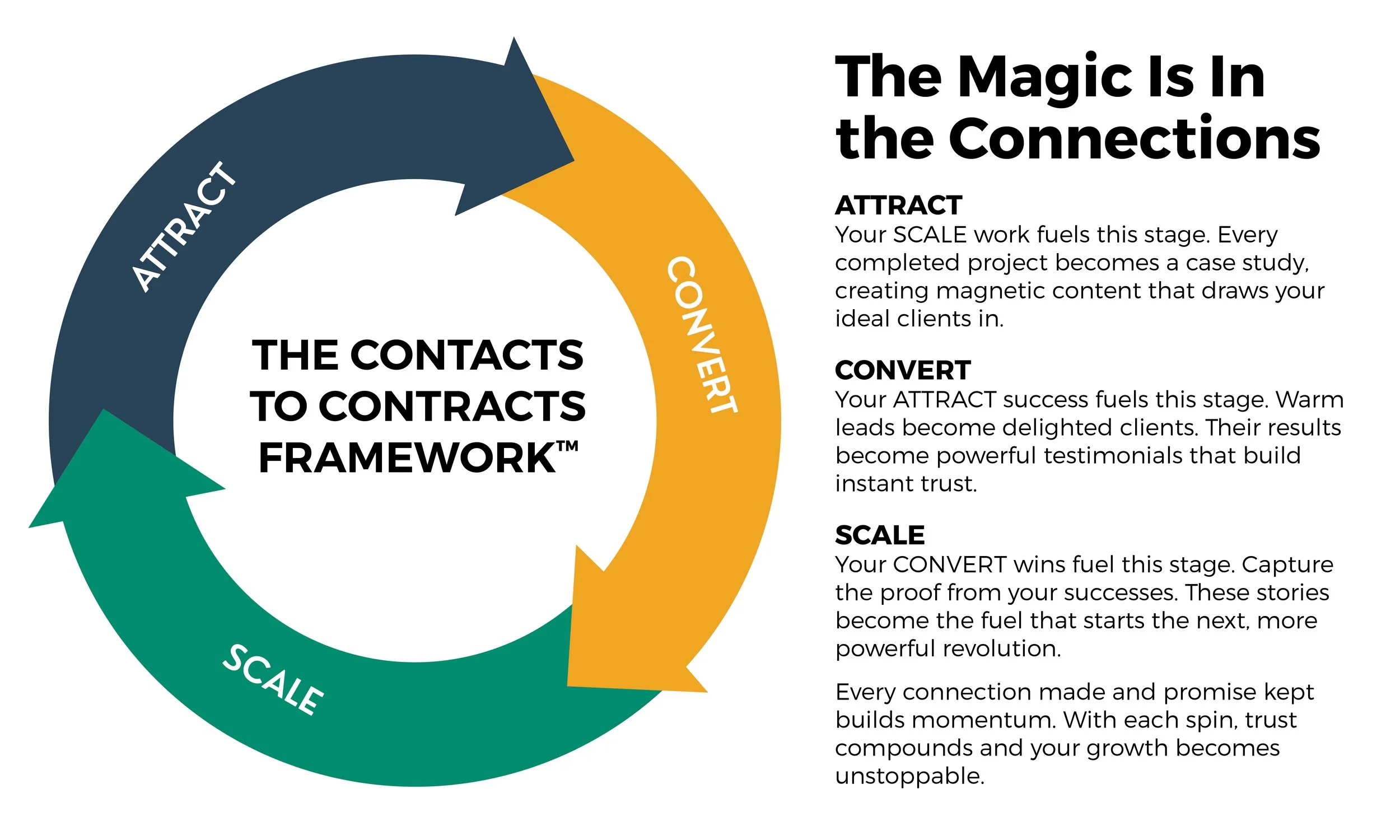
Let’s break down how this framework directly addresses the differentiation dilemma:
1. ATTRACT: Stop Selling, Start Teaching
The goal of the Attract phase isn't to land a project; it's to land a relationship by providing immense value upfront. Instead of talking about your capabilities, you demonstrate them.
The Problem: Your marketing talks about "quality," but it doesn't show it.
The Solution: Become a source of invaluable knowledge. Create content that solves your ideal client's problems before they even break ground.
Example: Instead of a “We Build Quality” tagline, publish a detailed case study on the specific challenges of achieving air-tight seals in a healthcare facility, complete with data, BIM coordination screenshots, and testimonials from the facility manager.
Example: Host a webinar for real estate developers on "The 3 Hidden Budget Killers in Multi-Family Construction and How to Avoid Them."
By teaching, you don’t just say you’re an expert—you prove it. You attract clients who value your knowledge and see you as a strategic advisor, not just a bidder.
2. CONVERT: Build Trust Through Process, Not Promises
A potential client is interested. Now what? The Convert phase is about systematizing how you build trust and demonstrate your unique approach, turning a warm lead into a signed contract.
The Problem: Your sales process is reactive and inconsistent, often defaulting to price discussions.
The Solution: Develop a “Trust-Building” sales process that showcases your differentiators in action.
Example: Create a standardized client onboarding presentation that doesn’t just list your past projects, but visually walks them through your exclusive project management software, your dedicated communication protocol, or your proprietary pre-construction de-risking process.
Example: Develop a series of discovery questions that are laser-focused on uncovering the client's deepest fears (e.g., budget overruns, timeline delays) and then present your specific processes designed to mitigate those exact risks.
When you can articulate a clear, professional, and reassuring process, you are no longer a commodity. You are a specialist with a proven methodology for success.
3. SCALE: Systematize Your Uniqueness
You can’t be the only differentiator in your company. The Scale pillar is about solidifying your unique value into the fabric of your organization, ensuring it’s delivered consistently across all projects and by all team members.
The Problem: Your differentiators live only in the owner's head or in a few star project managers.
The Solution: Document and systemize what makes you great.
Example: Is your “quality’ actually your unique post-occupancy warranty and 9-month walk-through process? Document it, brand it, and make it a standard part of your proposal.
Example: Is your “safety” defined by your proprietary daily huddle system that has resulted in a recordable incident rate 50% below the industry average? Train every team on it and feature this data prominently.
When your unique approach is baked into your company’s systems, it becomes repeatable, marketable, and defensible against lower-priced competitors.
Here’s Your Chance
This is an opportunity for your company is to break the cycle. By shifting your focus from hollow claims to a strategic, value-driven marketing system, you can finally articulate a UVP that resonates, justifies your value, and wins you the projects you truly want. Download the “UVP Quick-Start Worksheet” below to see how your company stands out among the competition.