
Two Crayons. Four Colors. One Big Lesson for Construction Marketing.
A few weeks ago I found myself at dinner with my husband, my daughter, and my two-and-a-half-year-old grandson. Like most family-friendly restaurants, the hostess set a children's menu and a small pack of crayons down in front of him.
I almost didn't look twice. Crayons are crayons. You've seen them a thousand times—the four-count wax pack, usually some off-brand set that doesn't quite match what it says on the label.
But these were different.
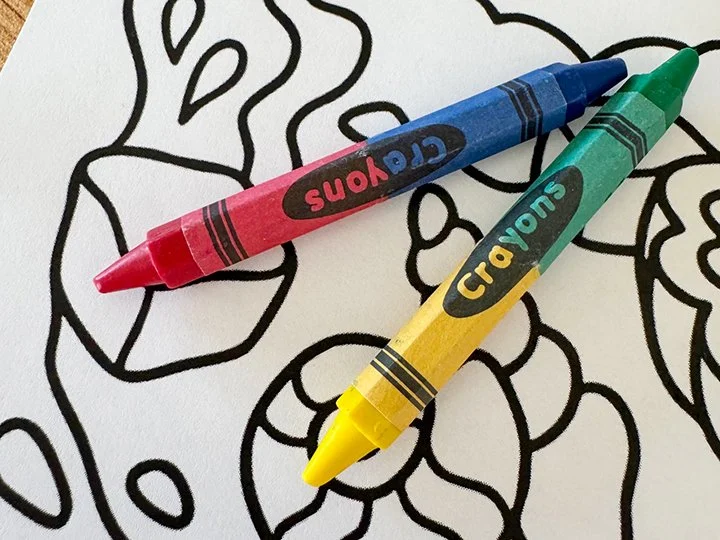
There were just two of them. And the moment I picked one up, I noticed they were hexagonal. Not round. Not the standard cylindrical shape that rolls off the edge of the table and hits the floor before the bread basket arrives. Six flat sides that sit exactly where you set them.
And then I turned it over. Double-tipped. A different color on each end.
Two crayons. Four colors. Zero trips under the table.
I sat there for a moment (probably longer than my husband and daughter thought was entirely normal) just thinking about the design decisions behind these crayons. Somebody looked at the problem of restaurant crayons and asked a very deliberate question: what's actually broken here, and how do we fix it?
They didn't just make a better crayon. They thought about the whole experience.
“Innovation isn't usually a lightning bolt of inspiration. It's the result of paying
close attention to something everyone else has stopped questioning.”
Thinking Outside the Box Isn't About Being Creative. It's About Being Observant.
That's the part most people miss. Innovation isn't usually a lightning bolt of inspiration. It's the result of paying close attention to something everyone else has stopped questioning.
For more than 40 years, I've watched construction companies approach their marketing the same way restaurants used to hand out round crayons: it works well enough, so why change it? A capabilities brochure. A logo on a truck. Maybe a website that hasn't been touched since 2019. A handshake and a referral network.
And for a long time, that was enough.
It isn't anymore.
Owners, facility managers, and architects are making pre-selection decisions before they ever pick up a phone. They're searching online, reading industry content, and evaluating your digital presence against your competitors'. And if what they find doesn't match the caliber of work you do in the field, you're losing opportunities you never even knew existed.
The answer isn't to do more marketing. It's to look at what's actually broken and fix it—the same way that crayon designer looked at a round crayon rolling off a table and decided there was a smarter way.
The Small Changes That Make a Measurable Difference
When I work with general contractors, specialty subcontractors, design-builders, and construction managers, the problems I find are rarely catastrophic. They're more like that round crayon: a small design flaw that creates a friction point nobody talks about because nobody stopped to question it.
Here are the ones I see most often.
1. Your capabilities statement is written for you, not for them.
Owners and facility managers aren't reading your capabilities brochure looking for your company history. They're reading it looking for evidence that you understand their problems. The shift from “here's what we do” to “here's how we think about what you need” is subtle, but it's the difference between a brochure that gets put in the circular file and one that gets shared.
2. Your website talks about projects. It doesn't talk about outcomes.
Square footage, completion dates, project photos—these are minimum requirements. What owners and architects want to know is: what was the challenge, how did you navigate it, and what did the client ultimately get? Challenge. Solution. Result. (I written a lot about this framework. Read more about it here.) Case studies written through that lens tell a fundamentally different story than project data sheets, and they're far more persuasive at the pre-selection stage.
3. Your follow-up process relies on memory instead of a system.
The relationship-based nature of commercial construction is a real competitive advantage, but relationships don't maintain themselves. The contractors I've helped grow their pipelines most consistently are the ones who've built a simple, repeatable follow-up system: not aggressive, not transactional, just present. A relevant article. A project update. An invitation to a pre-construction walkthrough. A 9-month post-occupany walk-through (i wrote a blog about this too. You can read it out here). Something that keeps you visible between opportunities.
What Architects and Facility Managers Are Actually Looking For
Marketing to architects and engineers is a different conversation than marketing to owners or facility managers, and treating them the same way is one of the more common mistakes I see.
Architects want to know that you respect the design intent. That you'll flag constructability issues early, not after submittal. That your superintendent will be a collaborative partner on the job site, not a source of friction. Your content, your conversations, and your references should all speak directly to that.
Facility managers, on the other hand, are thinking about operations: minimal disruption, phasing plans, communication protocols, and what happens after substantial completion. They want to work with a contractor who understands that the building doesn't stop functioning just because there's construction happening inside or around it.
When your marketing speaks their language (actually their language, not contractor language dressed up in bullet points) you stop looking like every other company on the short list.
“You don't need a rebrand. You don't need a six-figure campaign.
You need fresh eyes and a willingness to fix what you've stopped questioning.”
The Lesson From Two Crayons
My grandson colored his menu, knocked his juice over twice, and had a wonderful time. The crayons never left the table and my grandson’s tiny hands only had to manage two crayons instead of four.
That crayon designer didn't reinvent coloring. They just paid attention to the experience from the user's perspective, identified small, but real, friction points, and made a considered change that solved the problems elegantly.
That's the opportunity sitting in front of most commercial construction companies right now. You don't need a rebrand. You don't need a six-figure marketing campaign. You need to look at your marketing the way that designer looked at those crayons: with fresh eyes, a clear understanding of who's on the other side of the table, and a willingness to make the change that moves you from “good enough” to genuinely better.
The contractors who do that work—who get serious about how they're showing up before the first conversation—are the ones building the kind of pipeline that doesn't depend on who you happen to run into at an industry event.
It starts with stopping to notice what you've stopped questioning.
P.S. I love those crayons so much that I brought them home. They sit on my desk as a reminder of how a small change can make a big difference.